

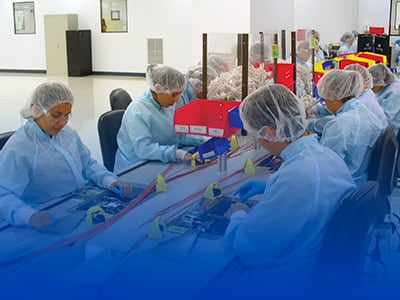
Why do medical device companies choose Costa Rica?
Costa Rica converted a strategic bet made in the 1980s into a specialized medtech cluster that now sits at the high end of the global value chain. Three data points frame the position:
- 48% of all Costa Rican goods exports are medical devices (2025), up from 12% in 2007
- ~52% of all new medical device FDI projects landing in Latin America in 2025
- 18 of 35 of the world's top medical device multinationals operate in Costa Rica
Medical devices are Costa Rica's number one export, representing 48 percent of all goods exports in 2025, up from 12 percent in 2007. The sector has grown at an 18 percent average annual rate from 2017 to 2025. Costa Rica captured approximately 52 percent of all new medical device FDI projects landing in Latin America in 2025 and ranked as the world's third-largest recipient of greenfield medtech investment projects.
The country hosts 18 of the world's top 35 medical device multinationals, including Boston Scientific, Abbott, Medtronic, Edwards Lifesciences, Baxter, Philips, Hologic, Coloplast, Terumo, Cardinal Health, Smith+Nephew, and J&J. Product complexity has climbed from disposables in the early 2000s to today's mix of catheters, structural heart valves, neurovascular devices, orthopedic implants, and Class III therapeutics.
How large is Costa Rica's medical device sector today?
Headline figures for the most recent reporting period:
- US$10,991MMedical device exports, 2025
- 18%Average annual growth, 2017–2025
- 100+Multinational medical device companies
- 62,000+Direct sector employment
- 18Top-35 global medtech OEMs present
- #2Latin America export rank
- 16Areas of medtech specialization
- 70FDA-registered establishments in Costa Rica
Also: US$8,675 million exported in 2024, 164 products shipped to 88 markets, ~52% of new LATAM medtech FDI captured in 2025. Trade statistics for 2024–2025 compiled by PROCOMER. FDA registrations from the US FDA Establishment Registration & Device Listing (2026). All other sector figures from CINDE Research, updated as of 2026.
Which medical device companies manufacture in Costa Rica?
The cluster spans market-leading OEMs, contract manufacturers, and specialty component suppliers. Selected operators by therapeutic focus; all operations are publicly disclosed.











-
Cardiovascular and structural heart
Boston ScientificAbbottEdwards LifesciencesTerumo CardiovascularStrykerCardinal HealthKardium -
Neurovascular and neuromodulation
Terumo NeuroBoston ScientificNevroRhythmlink -
Orthopedics and sports medicine
Medtronic (spine)Smith+NephewZimmer BiometJ&J Medtech -
Minimally invasive surgery and endoscopy
Boston ScientificMozarc MedicalSwitchback MedicalCath X (Zeus)PhilipsPenumbra -
Diagnostics and imaging
HologicPhilips (intravascular imaging)Roche -
Aesthetics and reconstruction
Establishment Labs (Motiva, global HQ)AbbVie (Allergan) -
Infusion, IV, and drug delivery
BaxterICU MedicalMoog MedicalCardinal Health -
Blood, cell, and apheresis
Terumo BCT -
Dental and orthodontics
Align TechnologyStraumannDDS Lab (regional services)
Boston Scientific is Costa Rica's largest medtech employer, having grown to approximately 10,000 employees across sites in Coyol (Alajuela), Global Park (Heredia), and its newest plant in La Lima Free Zone (Cartago), which opened in 2026 alongside a Costa Rica Global Hub for R&D and corporate services. Establishment Labs, a Costa Rican company traded on NASDAQ as ESTA, operates its global headquarters and Sulàyöm Innovation Campus in Coyol Free Zone.
What has been announced recently? Notable 2024–2026 investments
Costa Rica's cluster continues to compound. More than 20 new plants, expansions, and service centers are scheduled to begin operations between 2025 and 2027.
-
April 2024
Shockwave Medical (J&J MedTech) inaugurated its first plant outside the United States at Coyol Free Zone, with US$40 million committed through 2028 and approximately 1,200 jobs projected. Announcement
-
Early 2025
Edwards Lifesciences opened a Corporate Services Center at La Lima Business Park, diversifying beyond its structural heart manufacturing footprint.
-
August 2025
Zimmer Biomet announced its first greenfield plant in nearly two decades: a 22,000 m² orthopedic components facility in Costa Rica Green Valley (Grecia), projecting 500 jobs by 2033.
-
September 2025
Freudenberg Medical opened its second Costa Rican production facility with US$25 million invested, scaling from 350 to 900+ employees within three years. Announcement
-
January 2026
Coloplast opened its Business Centre for the Americas, complementing its two manufacturing plants and more than 1,000 employees in La Lima. Coloplast in Costa Rica
-
Early 2026
Mozarc Medical announced its new manufacturing plant for kidney health solutions in La Lima Free Zone, an operation of 4,000 sqm.
-
2027 (target)
Penumbra selected Zona Franca La Lima for a new manufacturing plant with operations targeted for 2027 and 200+ high-skill positions.
See the full 2025–2027 project pipeline (21 projects)
| Company | Target | Focus & size |
|---|---|---|
| La Lima Free Zone · Cartago | ||
| Boston Scientific (new facility) | Q4 2025 | 500,000 sqft, 3rd-site expansion |
| MGS | Q4 2025 | 160,000 sqft, injection molding & contract manufacturing |
| Penumbra | H2 2026 | 300,000 sqft, neurovascular devices |
| LifeSync | H2 2026 | 40,000 sqft, medical cables & interconnect |
| Mozarc Medical | Q4 2026 | 45,000 sqft, catheter solutions |
| Cath X (Zeus) | Q1 2027 | 30,700 sqft, extrusion & contract manufacturing |
| Kardium | Q3 2027 | Atrial fibrillation devices |
| Evolution Free Zone · Grecia, Alajuela | ||
| Stryker (Inari Medical) | Q4 2025 | 70,000 sqft, cardiovascular devices |
| Trelleborg | Q1 2026 | 100,000 sqft, silicone molding & assembly |
| Johnson & Johnson | Q3 2026 | 204,000 sqft (first phase) |
| Costa Rica Green Valley · Grecia, Alajuela | ||
| Nelipak (new facility) | H2 2026 | 60,700 sqft, thermoforming & packaging |
| Zimmer Biomet | Q4 2026 | 235,000 sqft, orthopedics |
| Promed | Q4 2026 | 39,000 sqft, silicone molding |
| Parque Activa Free Zone · Grecia, Alajuela | ||
| HST Seals | Q2 2026 | 13,000 sqft, injection molding, CNC & assembly |
| EPFlex | H1 2026 | 13,000 sqft, minimally invasive devices |
| Coyol & GreenPark Free Zones · Alajuela | ||
| Switchback Medical (Coyol) | Q3 2026 | Contract manufacturing |
| Rhythmlink (GreenPark) | Q3 2026 | 45,000 sqft, neurovascular devices |
| Other locations | ||
| Gauss | Q3 2026 | 15,000 sqft, contract manufacturing |
| Surface Solutions Group (location TBC) | H1 2027 | Coating services |
| Prent (new facility, Savia FZ, Heredia) | Q2 2027 | 60,700 sqft, thermoforming & packaging |
| Medical Component Specialists (La Ceiba FZ, Orotina) | TBC | Contract manufacturing |
Source: public company press releases and CINDE / COMEX announcements, 2026.
In 2025, CINDE facilitated 19 new FDI projects and 48 reinvestments across sectors, with life sciences contributing 13 of the reinvestments.
How does Costa Rica compare to Mexico, the Dominican Republic, and Puerto Rico?
For US decision-makers, the relevant comparison is not "cheapest" but "best-fit for efficient, high-complexity manufacturing." The table below summarizes the most-cited variables.
| Factor | Costa Rica | Mexico | Dominican Republic | Puerto Rico |
|---|---|---|---|---|
| Fully loaded operator wage (est. 2024–2026) | US$4.50–$6.50/hr | US$5.56–$8.50/hr | US$2.50–$3.50/hr | US$14–$20/hr |
| Engineer / technician wage | US$8–$14/hr | US$8–$15/hr | US$5.50–$9/hr | US$25–$40/hr |
| Time zone vs US Central | Same (UTC-6, no DST) | Same or ±1 hr | UTC-4 (1 hr ahead of CT) | UTC-4 |
| Duty-free access to US | CAFTA-DR | USMCA | CAFTA-DR | Domestic |
| Democracy Index 2025 (EIU) | 8.29 Full Democracy | Flawed | Flawed | US territory |
| Renewable electricity share | 98.6% (2025) | ~30% | ~15% | ~20% |
| Rule of Law Index 2025 (WJP rank) | 28 / 143 | ~121 / 143 | Mid-tier | US territory |
| Deep medtech cluster | 100+ firms, 18 of top 35 | Large, disposables-heavy | Growing, disposables focus | Established but shrinking |
| Best-suited for | Class II and III complex devices, high value supplier base | High-volume disposables | Cost-driven disposables | Sterile pharma-adjacent |
Sources: EIU Democracy Index 2025 · World Justice Project Rule of Law Index 2025 · Grupo ICE 2026 · wage estimates from industry surveys 2024–2026.
Costa Rica's differentiators are talent depth, regulatory maturity, and ESG-grade electricity, positioning the country for complex, regulated Class II and III devices. Labor represents roughly 70 percent of medtech production cost, so the operator-wage gap between Costa Rica and the US mainland (~25–30 percent savings) compounds materially at scale.
See the full Costa Rica vs Mexico vs Colombia comparison in our Nearshoring guide

Where is the talent, and how bilingual is it?
Engineering depth and English fluency are what let Costa Rican plants run Class II and III lines to FDA and EU standards.
- ~6,000engineers graduate per year
- 31.3%of new tertiary entrants choose STEM (7th of 35 countries, OECD)
- 3rd in LATAM44th globally on the INSEAD Global Talent Competitiveness Index 2025
Costa Rica graduates approximately 6,000 engineers per year across public and private universities, with STEM representing roughly 18 percent of bachelor's degree completions (OECD Education at a Glance, 2025). New tertiary entrants in STEM fields represent 31.3 percent, ranking Costa Rica 7th of 35 comparable countries (OECD, 2025). Total tertiary graduates exceed 60,000 per year across public and private institutions (CONARE).
Costa Rica ranks 3rd in Latin America and 44th globally in the 2025 INSEAD Global Talent Competitiveness Index, ahead of both Brazil and Mexico (INSEAD, 2025). English is widely used across technical and managerial roles in the medtech cluster, with engineers and quality teams routinely operating in both U.S. FDA and EU regulatory frameworks (The European, 2026).
Which free zones host the medtech cluster?
Costa Rica's Free Trade Zone regime, governed by Law 7210 and administered by PROCOMER, is where nearly every medtech plant operates.
- 0% income taxfor the first 8 years, then a reduced rate for 4 more; resettable through reinvestment
- 0% VAT & import dutieson machinery and raw materials, indefinitely
- 0% on remittancesfull exemption on profits sent abroad
- US$150,000minimum initial investment in fixed assets inside a park
How Costa Rica's Free Trade Zone regime works
-


Coyol Free Zone Alajuela
The flagship medtech cluster. It houses roughly 34 companies, including 8 of the world's top 35 medical device OEMs (Boston Scientific, Medtronic, Abbott Vascular, Philips, Cardinal Health, Terumo Neuro, Smith+Nephew, Hologic) plus Establishment Labs, Shockwave Medical, Moog, Freudenberg, and Cirtec.
It sits 5 to 10 minutes from Juan Santamaría International Airport and has been repeatedly recognized by fDi Intelligence as one of the top free zones globally. Coyol generated more than US$4.4 billion in exports in 2023 (Coyol FZ, 2024).
See the zone -
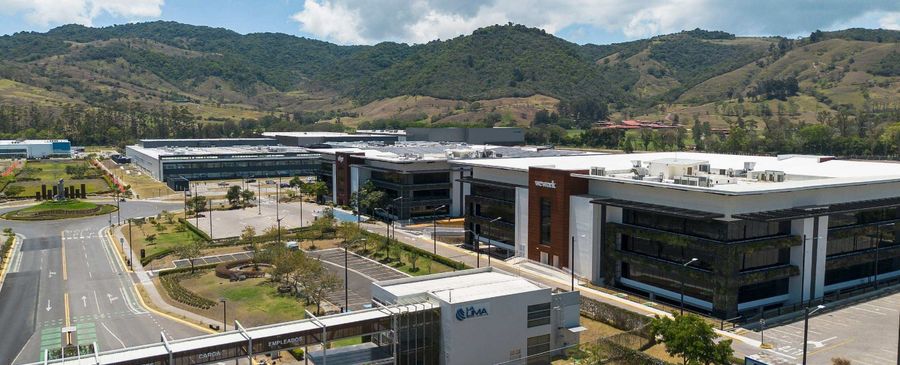

La Lima Free Zone and Business Park Cartago
Anchors the eastern cluster with Edwards Lifesciences, Coloplast, Mozarc Medical, Terumo BCT, Terumo Cardiovascular, Align Technology, and Penumbra.
Boston Scientific opened its third Costa Rican plant here in 2026, alongside its Costa Rica Global Hub. La Lima is Carbon Neutral certified and sits 30 to 40 minutes from SJO via Route 27.
See the zone -


Evolution Free Zone Grecia, Alajuela
The newest high-tech park from the developer of Coyol, with confirmed tenants including Stryker Peripheral Vascular manufacturing, Trelleborg, Johnson & Johnson, and Switchback Medical.
See the zone -


Additional medtech-heavy zones
Costa Rica Green Valley (Grecia) hosts Zimmer Biomet's greenfield orthopedic plant, Nelipak, and Promed. The Green Park Free Zone (Alajuela) hosts Harland Medical Systems' hydrophilic coatings center of excellence. Global Park Free Zone (Heredia) hosts Boston Scientific's first Costa Rica plant, ICU Medical, and AbbVie.
See Costa Rica Green Valley


Is Costa Rica FDA-aligned?
Yes. FDA authorizations are formally recognized, and 70 local establishments are FDA-registered for medical device manufacturing.
- FDA 510(k), De Novo & PMArecognized by the Ministry of Health (Decree DM-F-1518-2011)
- 70 establishmentsFDA-registered for device manufacturing (2026)
- ISO 13485certified quality systems at most sites
- MDSAPone audit for US, Canada, Brazil, Japan and Australia
Costa Rica's Ministry of Health formally recognizes FDA 510(k) clearance, De Novo, and PMA approvals, providing a simplified registration pathway for FDA-authorized Class III and IV devices (Decree DM-F-1518-2011). As of 2026, 70 Costa Rica-based establishments are FDA-registered for medical device manufacturing (US FDA Establishment Registration & Device Listing, 2026), and most operate ISO 13485-certified quality management systems.
Multinational operators typically hold MDSAP audit certifications at their Costa Rica sites, satisfying US, Canada, Brazil, Japan, and Australia simultaneously. The Costa Rican regulatory framework uses a four-tier risk classification based on Health Canada's model, and PAHO is supporting the Ministry toward WHO Level 3 regulatory maturity.
What about political stability and ESG credentials?
A continuous democracy since 1948, with no army, top-tier rule of law in Latin America and an electricity grid that is 98.6% renewable.
- 8.29EIU Democracy Index 2025 · full democracy, 19th worldwide, 2nd in Latin America
- 28 / 143WJP Rule of Law Index 2025 · 2nd in Latin America, 1st among upper-middle-income economies
- 56 / 100Transparency International CPI 2025 · rank 46
- 98.6%renewable electricity in 2025 · net-zero commitment by 2050
Costa Rica abolished its army in 1948 and has been a continuous democracy ever since. The EIU classifies it as one of only 25 full democracies globally, with a 2025 score of 8.29 that ranks it 19th worldwide and second in Latin America (EIU, 2026). The World Justice Project Rule of Law Index 2025 ranks Costa Rica 28th of 143 countries, second in Latin America behind Uruguay and first among all 41 upper-middle-income economies (WJP, 2025). Transparency International's Corruption Perceptions Index 2025 places Costa Rica at rank 46 with a score of 56/100 (Transparency International, 2026).
On sustainability, Costa Rica generated 98.6 percent of its electricity from renewable sources in 2025 across hydro, geothermal, wind, biomass, and solar (Grupo ICE, 2026). The country has committed to net-zero emissions by 2050 under its National Decarbonization Plan. For medtech OEMs reporting under SBTi, CSRD, or corporate ESG targets, this materially lowers Scope 2 emissions from Costa Rican operations.

Which free trade agreements protect your exports?
Costa Rica maintains preferential access to more than 50 markets through 18 agreements. The most relevant for medtech exports:
- CAFTA-DRDuty-free access to the United States for qualifying goods, in force since January 2009.
- EU–Central America Association AgreementPreferential access to the EU-27, provisionally applied since 2013.
- China–Costa Rica FTACovers roughly 99.6 percent of Costa Rican exports duty-free.
- CPTPPAccession substantially concluded at the November 2025 Ministerial in Melbourne; the protocol is being finalized (DFAT Australia, 2025).
Additional agreements cover Canada, Mexico, Chile, Peru, Colombia, Singapore, EFTA, and CARICOM.
Ready to model Costa Rica against your site selection shortlist?
CINDE provides customized cost, talent, and site-selection analyses at no cost to qualified investors.